





 Welcome to the annual talk given on 23April, the Bard's birthday...
The Shakespeare Lecture twenty twenty-two
is on The Friday Club, a group of wits
contemporary with the Bard, who met
for drinks and conversation at the Mermaid
Tavern, Friday Street, beside St Paul's.
Mermaid is sirène in French and so
their formal name was the Fraternity
of the Sireniacal Gentlemen.
Their gatherings were monthly, each first Friday,
and the repartee, according to
the playwright Francis Beaumont, who was there,
was like a verbal tennis match. 'We left
an air behind us which alone was good
to make the next two companies right witty,'
Beaumont wrote to Jonson in blank verse.
Was William Shakespeare in the Friday Club?
His name's conspicuously. absent. All
the members went to Oxford or to Cambridge,
some to both, but Shakespeare hadn't been
a student anywhere. His father traded
leather goods in Stratford Upon Avon
and expected Will to do the same.
The Mermaid wits sneered at the lower class.
Bishop's son John Fletcher in his play
The Woman Hater has a character
derided as a social climber and
whose father is a manufacturer of gloves.
The Jacobean public got the joke.
A few years later in sixteen o nine,
John Fletcher actually succeeded Shakespeare
as the playwright of the The King's Men, Shakespeare's
troupe. In fact they worked together for the last
three years of Shakespeare's time in London which
was surely awkward given Fletcher's slight.
The Friday Club, it's said, was founded by
Sir Walter Raleigh in sixteen o three.
The pirate then was fifty. He was sent
to prison in July that year, so if
he was the founder, he may not
have got to many meetings. Raleigh was
at Oxford briefly thirty years before
but never graduated. He switched course
to Law in London but again quit early
and so lacked the skills he needed when
in court he chose to mount his own defence.
The jury found him guilty. He was punished,
not thank goodness with beheading but
indefinite incarceration in
the Tower of London. Raleigh's cell was in
the Garden Tower, known to later ages
as the Bloody Tower. Mrs Raleigh
and their son came too. They occupied
two floors. Sir Walter did the gardening ,
grew herbs, potatoes and tobacco, and
he wrote his multi-volume Historie
of England in his cell. He even had
a second child inside with Bess his wife
who came and went at will presumably.
Perhaps his terms allowed him day-release.
If so he might have made the monthly meetings
after all with Beaumont and the boys.
The king had no desire to upset
the public by decapitating Raleigh,
but wished only to restrict his movements
as, whenever he went travelling,
his voyages turned into piracy
and soured international relations.
Sir Walter was a wanted man in Spain.
Sir Walter Raleigh was the oldest member
of the club by twenty years. The next
most senior was Richard Martin, born
in fifteen seventy. He went to Oxford,
then aged seventeen came down to London
where he trained for fifteen years to be
a barrister - a record length of time.
He spent the years enjoying London life
as something of a playboy Tudor-style.
It didn't take him long to find the pub.
The landlord said he never missed a week.
The others knew him as 'the handsome one'.
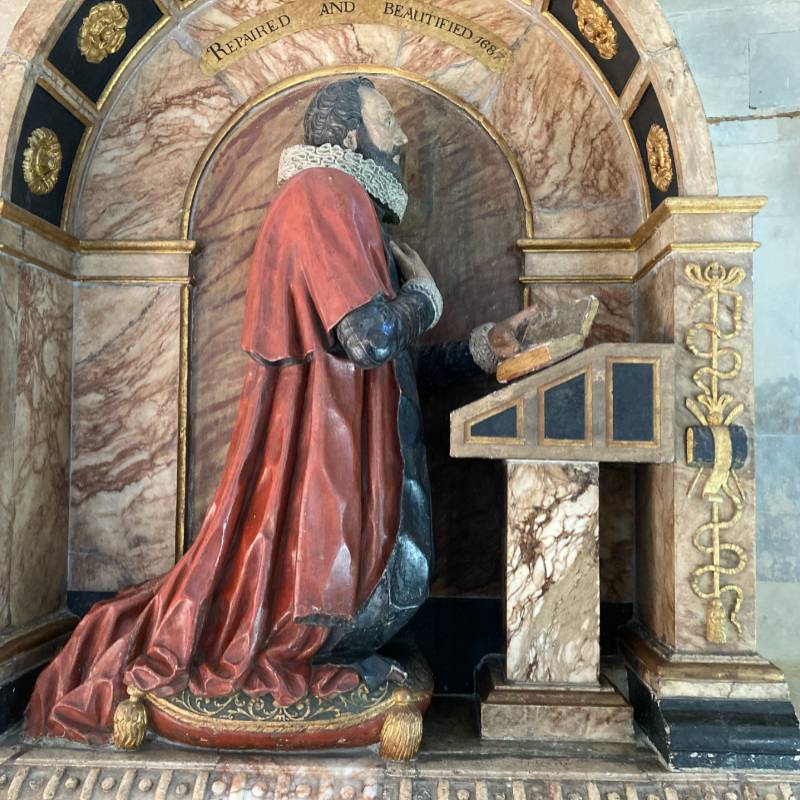
His effigy above his ornate tomb
in Temple Church has chiselled cheekbones. Greetings,
Readere, runs his epitaph in Latin:
Here lies Richard Martin. If you wish
to know the rest, enquire. At the Christmas
Revels fifteen ninety seven in
the Middle Temple, he was made the Prince
of Love, a part requiring skills in music.
He could dance and sing and play the lute.
That's why it took so long to qualify.
He set to music lyrics by the Earl
of Essex whom Elizabeth the First
beheaded. Here is Rick to sing them now.
CHANGE THY MIND
Richard Martin often caused offence.
A fellow lawyer, victim of his satire,
hit the perpetrator with a stick
so hard, it broke in half, an incident
which went to court for an apology.
Did Martin aim his barbs at Shakespeare too?
Quite probably. Since fifteen ninety-two
when Shakespeare, newly come to London, was
described as 'upstart crow' by Cambridge author
Robert Greene who also died that year,
the Bard had been the butt of class-based jokes.
The next in age among the members of
the Friday Club was Robert Cotton, late
of Jesus College Cambridge and the Middle
Temple where he also studied law.
When he was young his hoppy was collecting
ancient manuscripts. He purchased them
from lots acquired when the monast'ries
disgorged their treasures and eventually
the Cott Library exceeded even
what the king possessed. Sir Robert owned
the parchment manuscript of Beowulf,
an Anglo-Saxon epic poem written
in the time of King Canute, a Greek
fifth century Bible and the gospels from
the monast'ry at Lindisfarne whose artists
had no primitive ability.
The wondrous past revealed itself to him.
His exhibits included Roman coins
and he explored the fields at Hadrian's Wall.
His libr'ry was long and narrow as
a cricket pitch with shelves identified
by busts of classical personae like
Vitellius, Caligula and Nero.
It made Cotton's London residence
a meeting place for antiquarians.
His home in Huntingdon was where his wife
and children lived. They separated for
a while and Cotton, who was said to have
great charm, moved in with Lady Hunsdon, widow
of the Baron Hunsdon who'd been Shakespeare's
patron as Lord Chamberlain. And so
again the gulf between professionals
and players, management and grafters, toffs
and working classes, is exemplified.
The low must dedicate its work to high.
Here's Lady Hunsdon's Puff, a merry dance.
LADY HUNSDON'S PUFF
The next Sireniacal Gentleman
in seniority was William Strachey,
student of Emmanu'l College Cambridge,
which produced the puritans that filled
the colonies across the ocean in
America. Although young Strachey was
no pious idealist, he had a taste
for fun and for adventure in pursuit
of wealth. The pub, The Mermaid was around
the crner from the Blackfriars Monast'ry
which was a theatre when the minks were sacked.
Strachey was a shareholder in both
the theatre and the company which played
in it, The Children of the Revels. They had
staged John Fletcher's play The Woman Hater
with its Shakespeare insult. His investments
didn't pay as he had hoped and so
he took a lucrative position as
a clerk to the ambassador in Turkey,
but they argued and he was dismissed.
He purchased shares in the Virginia Co
which fuonded in sixteen o seevn Jamestown,
first of English colonies in North
America. STrachey sailed there two
years later on the Sea Venture which foundered
in a gale. The captain ran the ship
aground off uninhabited B`ermuda,
shouting to the crew to take their chance.
Survivors _ Strachey with them - foraged as
they built two new boats from the wreck and after
several months, sailed on to Jamestown. Not
all went; a few remained to found New London.
Jamestown occupied some acres in
Powhatan country - native population
fifteen thousand over twenty square
kilometres. Initially respect
was mutual: the Eng;ish would have starved
without Powhatan help. In sixteen eight,
the company sent Captain Christopher
Newport with fresh supplies, more colonists
and gifts from James the First - a red cloak and
a copper crown - which Newportgave Powhatan
after travelling for a week up river to
Werowocomoco the capital.
Powhatan gave his shoes and calfskin mantle
with embroidered seashells in exchange.
These Jamestown owned when Strachey turned up with
the remnants of the crew of the Sea Venture.
Strachey stayed some months as secretary
of the colony and wrote about
the shipwreck and the Jamestown misery
in an account he dated sixteen ten.
The mantle was acquired by John Tradescant
Junior in sixteen thirty-seven
who had travelled to Virginia on
behalf of `charles the first to gather plants.
He bought the mantle and displayed it at
his cabinet of curiosities,
The Srk in Lambeth, but at some point sold
it to Elias Ashmole who in turn
bequeathed it to his university.
In London the Virginia Company
refused to publish Strachey's negative
first-hand report but it was doubtless
seen and read by the Sireniacal
Gentlemen and it is almost certain that
The Tempest, written sixteen twelve by William
Shakespeare was inspired by it. The play
commences with a shipwreck and a storm.
And Rick will sing the song Full Fathom Five.
FULL FATHOM FIVE
Contemporay with Bill Strachey
at the Mermaid were Ben Jonson and
JOh. Donne, all born in fifteen sev'nty-two.
A lot is known already of the latter
pair. Ben Jonson, though he had a place
at Cambridge, was prevnted from atteneding
by his stepfather who made him ake
up briclaying instead> His best-known verse
is spoken in a pub or somewhere people
share a loving cup. Drink to me only
with thine eyes, he wrote, and I will pledge
with mine. Or leave a kiss within the cup
and I'll not ask for wine. He also wrote
a poem To The Reader at the start
of The First Folio or Shakespeare's Works
of sixteen twenty-three. He says if only
the engraver could have cut his wit
as well as he had done his face, it would
surpass all writing hitherto in print:
But since he cannot, Reader, look
not on his picture but his book.
That is to say the text is more important
than the personality, a quote
which raises certain ambiguities -
and fuel for arguing another time.
John Donne was bachelor of arts at both
the universities. He was as wild
as any in his youth but latterly
became a priest and was appointed dean
aged fifty of St Paul's pre-Fire. His wit
he trained on abstract concepts like his God
inhabiting no physical domain
but metaphysical, as scholars say.
He lists in verse the sins he wallowed in
at Oxford, nagging God in a refrain
when thou hast done thou hast not done for I have more.
His wife was More, Anne More- and they were wed
against her father's wishfor which Donne was
imprisoned for a spell. When he emerged
he'd lost his government job and he was brassic.
John Donne - Anne Donne - Undone he declared.
He was a Roman Catholic which held
him back until he joined the English Church.
He gave himself to literature and the law
until in sixteen fifteen he became
a Church of England priest. People flocked
to hear his sermons. Charles the First
delighted in his humour and good sense.
He intellectualised the English church,
translating from the Latin as he went.
For in the end the difference between
the churches was linguistic rather than
the ornaments - and language was Donne's skill.
LACHRIMAE
Second youngest member of the group
was writer Thomas Coryat who walked
through Europe, Palestine and India,
gave ius the fork, the word umbrella and
his stories published in a book entitled
'Greetings from the Traveller to the English
Wits!' H`e went to Oxford like the others
but does not appear to have have continued
studying beyond that, as we find
him next as 'jester' to the ten-year-old
Prince Henry, elder son of James The First,
engaged to tell his Highness jokes.
Ben Jonson and John Donne were also hired
as private tutors to the future king
although their jobs were much more serious.
The jokes went on for four years by which time
the prince had hear them all so Coryat
said farewell to his pre-pubescent boss
and the Sireniacals, put on walking sandals,
replicas of which have been preserved
at Odcombe, Somerset, where he was born,
and went off backpacking round Europe, the
original Grand Tour, it has been said.
He walked through France and Italy to Venice
and returned through Alpine Switzerland
to Germany and Holland. He amused
the Mermaid drinkers with descriptions
of Italians impaling morsels on a trident
prior to consumption while the English
were still putting knives into their mouth.
He eulogised the walking-stick which had
been fitted with a mechanism to
erect a fabric shade against the sun,
an umbra-solar or umbrella which
he thought might also shield his friends from rain.
A new word entered the vocabulary.
Back in London Coryat resumed
his former ways. In sixteen twelve a jape
backfired which killed his erstwhile royal ward
the Prince of Wales now eighteen years of age.
The youth went swimming in the River Thames
to celebrate his sister's wedding, but
caught typhoid and within a week was dead.
The nation mourned and Coryat, who maybe
felt responsible, went travelling
again, but this time never to return.
He walked as far as Greece and Istanbul
and kept on walking into Persia now
Iraq and on to Moghul India
where he was welcomed by the Emperor
Jehangir Khan in Ajmer, Rajasthan.
His letters to the Friday Club were much
enjoyed and published with the title 'Greetings
from the Moghul Court, but posthumously
as in sixteen eighteen in Surat
Tom Coryat caught dysentery and died.

 Home
 Tours
 Private booking
 Your guide
 Blog
 Contact


